
.png)
Overwhelmed by Divorce? A Step-by-Step Guide to Regaining Control in 2026
- Mar 2
- 11 min read
Updated: Mar 3

Your mind is a storm of legal questions, financial worries, and what-ifs. Your body feels the weight of every sleepless night, and the fear of making a life-altering mistake can be paralyzing. This is what it feels like to be completely overwhelmed by divorce. You know you need to move forward, but the sheer volume of decisions-from dividing assets to planning for your future-can leave you frozen, unsure of where to even begin.
Take a steadying breath. This guide was created to be your calm in that storm. We will not bombard you with legal jargon or add to your stress. Instead, we provide a clear, step-by-step framework designed to help you regain control. You will learn how to silence the noise, organize your thoughts, and build a manageable path forward. This is your journey from emotional chaos to a place of clarity and hope, starting right now.
Key Takeaways
Understand that feeling overwhelmed by divorce is a biological response, and discover how to calm your nervous system to make clearer decisions.
Learn to manage the intense mental load of separation to avoid decision fatigue and protect your long-term legal and financial interests.
Access immediate grounding techniques to stop the panic cycle during high-conflict moments and regain your focus in under five minutes.
Implement a step-by-step framework that helps you stabilize your emotions first, creating a clear and manageable path forward.
Table of Contents
Why You Feel Overwhelmed by Divorce: Understanding the SOS State The Cognitive
Load of Separation: Why Your Brain Feels Broken Immediate Circuit-Breakers: How to
Stop the Divorce Panic Cycle From Chaos to Clarity: Implementing the THRIVE Method
Meeting Your Digital Companion: How Divorce SOS App Simplifies Recovery
Why You Feel Overwhelmed by Divorce: Understanding the SOS State
If you feel completely overwhelmed by divorce, you are not alone. This feeling is more than just stress; it’s a state of nervous system dysregulation. Your body has entered a survival mode, treating the end of your marriage as a genuine threat to your stability and safety.
This triggers a powerful instinct we call the 'SOS' state: Search, Organize, and Stabilize. You feel an urgent need to search for answers, organize endless paperwork, and stabilize your future. But this instinct often backfires. Instead of creating clarity, it can lead to frantic multitasking and burnout, making you feel even more lost.
The shift from a shared partnership to a solo operation is jarring. Suddenly, you alone are responsible for untangling finances, managing legal communication, and dissolving the formal legal duties and responsibilities of marriage. In 2026, this administrative burden includes a digital maze of shared accounts and online assets, adding a layer of complexity previous generations never faced.
The Symptoms of 'Divorce Brain'
This intense pressure often triggers 'divorce brain,' a biological response to trauma. Common symptoms include memory lapses, an inability to focus, and crippling decision fatigue. It feels like you're walking through a fog. You are not losing your mind. This is your nervous system protecting you by conserving energy for survival.
Why Traditional Advice Often Fails
Well-meaning advice to 'just take a bubble bath' can feel insulting when you're facing a court filing deadline. There is a massive gap between the legal system's rigid demands and your emotional capacity to meet them. You need a tool that honors both. A practical divorce handbook provides the step-by-step structure needed to regain control when everything feels chaotic.
The Cognitive Load of Separation: Why Your Brain Feels Broken
If your mind feels foggy and simple decisions seem impossible, you are not broken. You are experiencing the immense cognitive load of separation. Feeling overwhelmed by divorce is a direct result of your brain trying to process an unprecedented amount of new information and emotional stress. Understanding this process is the first step toward regaining clarity and control.
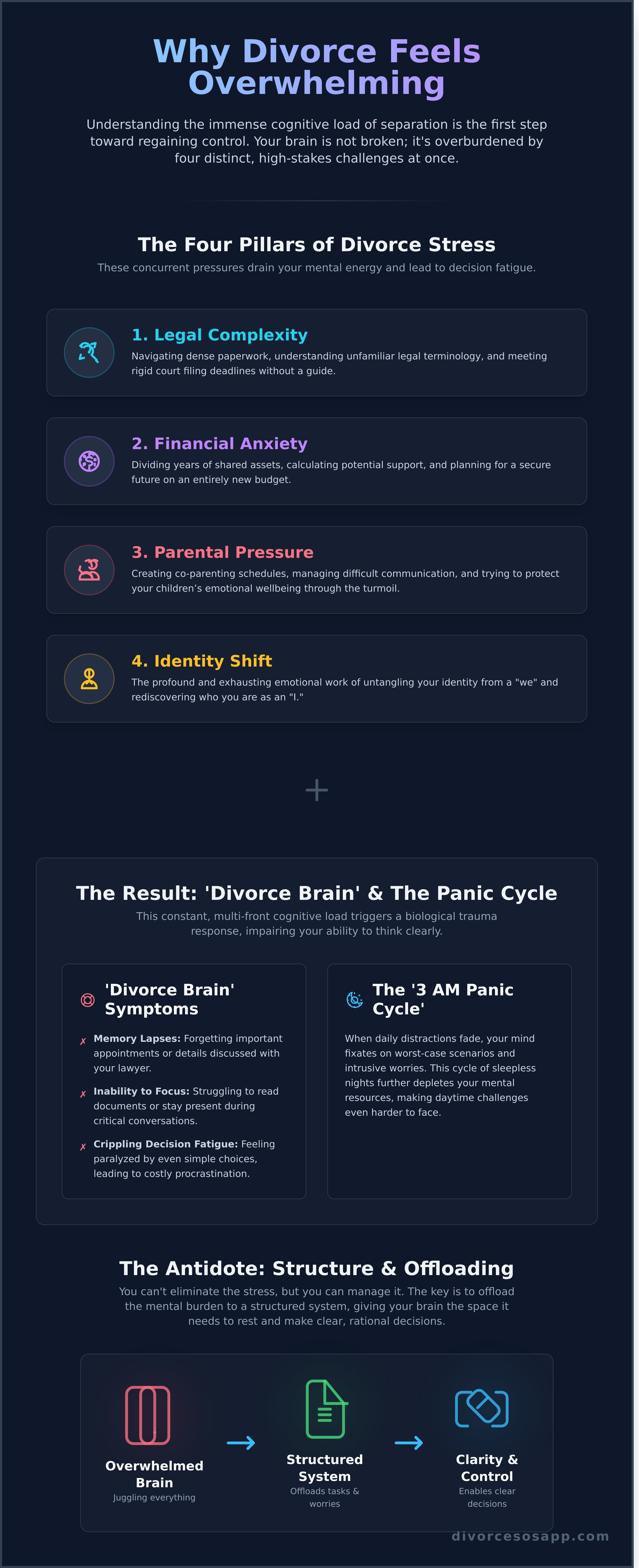
Your mental energy is being drained by four distinct, high-stakes areas at once. This isn't just a feeling; it's a measurable strain on your executive function.
The Four Pillars of Divorce Stress
The mental weight of divorce comes from juggling four critical and complex domains, often all at the same time:
Legal Complexity: Navigating dense paperwork, court filing deadlines, and unfamiliar legal terminology.
Financial Anxiety: Dividing shared assets, calculating potential support, and planning for a secure future on a new budget.
Parental Pressure: Creating co-parenting schedules, managing communication, and protecting your children’s wellbeing.
Identity Shift: The profound and exhausting emotional work of moving from a "we" to an "I."
Trying to manage these pillars simultaneously leads to severe decision fatigue, which can result in poor choices during mediation or in court. Your body enters a state of high alert, and this prolonged stress response floods your system with cortisol. This hormone impairs the part of your brain responsible for long-term planning and rational thought. In this state of chaos, structure is the only antidote.
Managing the '3 AM Panic Cycle'
This mental overload often peaks in the quiet of the night. When your mind is free from daily distractions, it fixates on worst-case scenarios and intrusive thoughts about your case. This is the '3 AM Panic Cycle,' and you need a system to offload these worries. Think of a divorce recovery app as an external hard drive for your brain. It securely stores your deadlines, documents, and communication logs, giving your mind the space it needs to rest. By entrusting the details to a structured system, you break the cycle of panic and empower yourself to make clear, confident decisions when it matters most.
Immediate Circuit-Breakers: How to Stop the Divorce Panic Cycle
When a difficult email arrives or a conversation turns hostile, your nervous system can trigger a panic response. Feeling overwhelmed by divorce is a signal that your emotional circuits are overloaded. The key is not to push through the panic, but to intentionally break the cycle. These immediate, five-minute strategies are designed to restore your sense of control right when you need it most.
Emotional Stabilization Techniques
When your heart rate spikes, your first job is to regulate your body. Use practical emotional grounding techniques to anchor yourself in the present moment. Start with Box Breathing: inhale for four seconds, hold for four, exhale for four, and hold for four. Repeat this four times. This simple act tells your brain you are safe. Developing these skills is a vital part of Coping With Separation And Divorce, as they directly manage your body's stress response.
Also, try a quick sensory check-in: Name 5 things you can see, 4 you can feel, 3 you can hear, 2 you can smell, and 1 you can taste. This pulls your focus away from anxious thoughts and back to your physical environment.
The 'Pause' Protocol for Communication
Impulsive responses escalate conflict. Institute a mandatory 'Pause Protocol' for all communication with your ex-partner or their attorney. Never reply to a triggering email or text in less than 20 minutes. Better yet, create 'Communication Windows'-specific times each day (e.g., 8:00 AM and 4:00 PM) when you address divorce matters. This prevents the stress from bleeding into your entire day and gives you back control over your time and attention.
When you do reply, use the BIFF method: Keep it Brief, Informative, Friendly, and Firm. This acts as a shield, protecting you from emotional bait while moving the process forward efficiently.
When your to-do list feels endless, activate the 'Rule of One.' Pick a single, manageable task-like scanning one document or making one phone call. Completing it creates momentum. Pair this with an 'Information Diet.' Endless Googling of legal outcomes fuels anxiety. Set a timer for research, and when it goes off, stop. Finally, remember that physical regulation is crucial. Prioritize sleep and use 'micro-movements' like stretching or a short walk to reset your nervous system when you feel overwhelmed by divorce.
From Chaos to Clarity: Implementing the THRIVE Method
When you feel completely overwhelmed, what you need is a clear path forward-not just more advice. At Divorce SOS App, we created the proprietary THRIVE method divorce support framework for this exact reason. It’s a step-by-step process designed to translate the chaos of divorce into a series of manageable actions, giving you the structure needed to move from crisis to clarity.
The method is built on a simple, powerful progression. First, you focus on emotional stabilization. Second, you regain control of the practical details. Finally, you begin envisioning and building your new future.
Stage 1: Anchoring the Ship
Before you can navigate the storm, you must anchor your ship. This first stage is about finding stability when your world feels like it's in constant motion. A critical step is learning to separate what you can control (your responses) from what you can't (your ex's actions). Start by building a 'Non-Negotiables' list for your mental health-a few simple, daily actions you commit to for your own well-being.
Daily Quiet Time: 10 minutes of uninterrupted silence.
Movement: A 15-minute walk, even just around the block.
Nourishment: One healthy, mindful meal without distractions.
Stage 2: Tending to Your Needs
Feeling overwhelmed by divorce depletes your energy reserves. The 'Tend to Your Needs' module helps you audit where your energy is going and reclaim it for what matters most. This is the time for radical self-preservation. Learn to delegate tasks, even small ones. Ask a friend to pick up groceries or a family member to watch the kids for an hour. This isn’t a sign of weakness; it’s a strategic move to protect your capacity.
Building a realistic self-care plan for divorce is not a luxury-it is essential for making sound decisions. Each small act of self-support builds the resilience you need for the legal and financial journey ahead. Our resources provide templates and guidance for creating a self-care plan for divorce that works for you.
Once you are anchored and your basic needs are consistently met, you create the space to look forward. The final stage, Envisioning a New Future, shifts the focus from surviving the present to designing a future you are excited to live. This structured approach is how you take back control, one step at a time.
Meeting Your Digital Companion: How Divorce SOS App Simplifies Recovery
When you feel completely overwhelmed by divorce, traditional support systems aren't always available at 2 a.m. This is where your digital companion comes in. The Divorce SOS App was designed to bridge that gap, offering a unique blend of clinical efficiency and deep empathy right on your phone. It provides a private, non-judgmental space to process your thoughts, vent your frustrations, and build a clear strategy forward. We turn your SOS signal into a planned journey.
Camille: Your AI companion for Separation
Meet Camille, your personal AI companion for separation, available any time of day or night. Unlike generic articles, Camille learns your unique situation to provide actionable, step-by-step guidance. This makes expert support accessible and affordable, giving you a powerful resource without the high cost of a traditional coach. It’s practical help, precisely when you need it.
Navigating separation often feels isolating. You may hesitate to share details with friends or family, fearing judgment or unsolicited advice. The Divorce SOS App provides a confidential sanctuary where you can organize your thoughts and prepare for crucial conversations. It helps you untangle complex emotions and legal tasks by breaking them down into manageable steps.
Organize Documents: Securely gather and store essential paperwork.
Track Communication: Log interactions to maintain a clear record.
Set Priorities: Focus on what matters most right now to reduce anxiety.
This structured approach is how we transform the chaos of feeling overwhelmed by divorce into a clear, methodical process. You are no longer just reacting; you are taking control.
Your First Step Toward a New Beginning
Downloading the app is more than just a click; it’s a symbolic act of reclaiming your power. In your first 24 hours, our THRIVE method will guide you through immediate, calming actions to establish a sense of stability. You’ll see a clear path forward, starting today. This is your first concrete step toward a new, empowered beginning.
Ready to move forward with clarity and confidence? Start your journey from overwhelm to empowerment with the Divorce SOS App today.
Your Next Step from Chaos to Clarity
The feeling of being completely overwhelmed by divorce is a natural, neurological response to immense strain. Your brain enters an SOS state, making even simple decisions feel impossible. But this feeling does not define your future. As we've covered, you can regain your footing by using immediate circuit-breakers to stop the panic cycle and then implementing a structured framework like the THRIVE Method. This is the path from chaos back to clarity.
You don't have to walk this path alone. We created a digital companion to be your steady guide. Founded by accredited divorce coach Camille Toscano, the Divorce SOS app places the structured THRIVE Method framework right in your hands. Get private, 24/7 on-demand emotional support and step-by-step guidance whenever you need it most. It's time to replace panic with a clear, manageable process.
Download the Divorce SOS App and meet Camille, your AI Divorce Coach. Your new chapter is not just possible; it's a process you can direct. Take the first step today.
Frequently Asked Questions
Is it normal to feel physically ill from divorce stress?
Yes, absolutely. The emotional stress of divorce often manifests physically. Your body can react with symptoms like chronic fatigue, headaches, digestive issues, or a weakened immune system. This is a normal mind-body response to a crisis. It is essential, however, to speak with your doctor to rule out other medical causes and get the support you need to manage these physical symptoms while you navigate this difficult period.
How do I handle legal deadlines when I can barely get out of bed?
When you feel paralyzed by overwhelm, focus on a single, small action. Instead of thinking about the entire case, ask yourself: "What is the one thing I can do in the next 15 minutes?" This could be finding one document or sending one email to your solicitor. Communicate your state clearly to your legal team. They can help you prioritize tasks, turning a mountain of work into a series of manageable steps. This is about progress, not perfection.
What is the difference between divorce coaching and therapy?
Therapy and divorce coaching serve different, yet complementary, roles. Therapy often focuses on healing by exploring your past and processing deep emotional wounds. A divorce coach is forward-looking and action-oriented. They provide practical strategies and a structured plan to help you navigate the legal, financial, and logistical challenges of your divorce. A coach helps with the 'how-to,' while a therapist helps with the emotional 'why.' Both are valuable forms of support.
Can an AI coach really help with the emotional side of divorce?
An AI coach acts as a 24/7 digital companion for structured support. It provides immediate access to coping mechanisms, organizational tools, and step-by-step guidance when you feel lost. While it doesn't replace human connection, it is a powerful tool for managing in-the-moment anxiety and breaking down complex tasks. It offers a private, non-judgmental space to process thoughts and regain a sense of control on your own schedule, right when you need it most.
How do I explain my 'overwhelmed' state to my solicitor without looking weak?
Frame your situation with professional clarity. Instead of saying, "I'm falling apart," try, "The stress of this process is impacting my ability to concentrate. To be most effective, could we create a prioritized list of the top three tasks for this week?" This approach demonstrates self-awareness and a commitment to moving forward. It positions you as a proactive partner in your own case, not a passive victim. Your solicitor will see this as a strength.
What should I do if my ex is intentionally making the process more overwhelming?
If your ex is creating conflict, shift your focus from their actions to your strategy. First, document every incident with dates, times, and specifics. Second, centralize all communication through a single channel, like email or your solicitor, to create a clear record. Inform your legal team of this pattern. They can then build a legal strategy to manage this behavior and protect your interests. This empowers you by moving from reaction to strategic action.
How long does the 'overwhelmed' stage of divorce typically last?
There is no set timeline, as everyone's journey is unique. The acute feeling of being overwhelmed by divorce is often tied to uncertainty. As you begin to make decisions, establish new routines, and finalize legal steps, this feeling typically lessens. The intensity will come in waves. Focus on navigating one day at a time with small, consistent actions. This focus on process, rather than the endpoint, is key to moving through this challenging stage with your well-being intact.


Comments